Ordering custom acrylic keychains directly from a manufacturer requires precise file preparation and an understanding of production logistics. When you bypass brokers and work with a factory that owns its UV flatbed printing equipment, you control the output quality, material selection and timeline. This guide details the exact technical specifications, artwork layer structures and shipping routes required to move your designs from digital files to finished hardware without errors or delays.
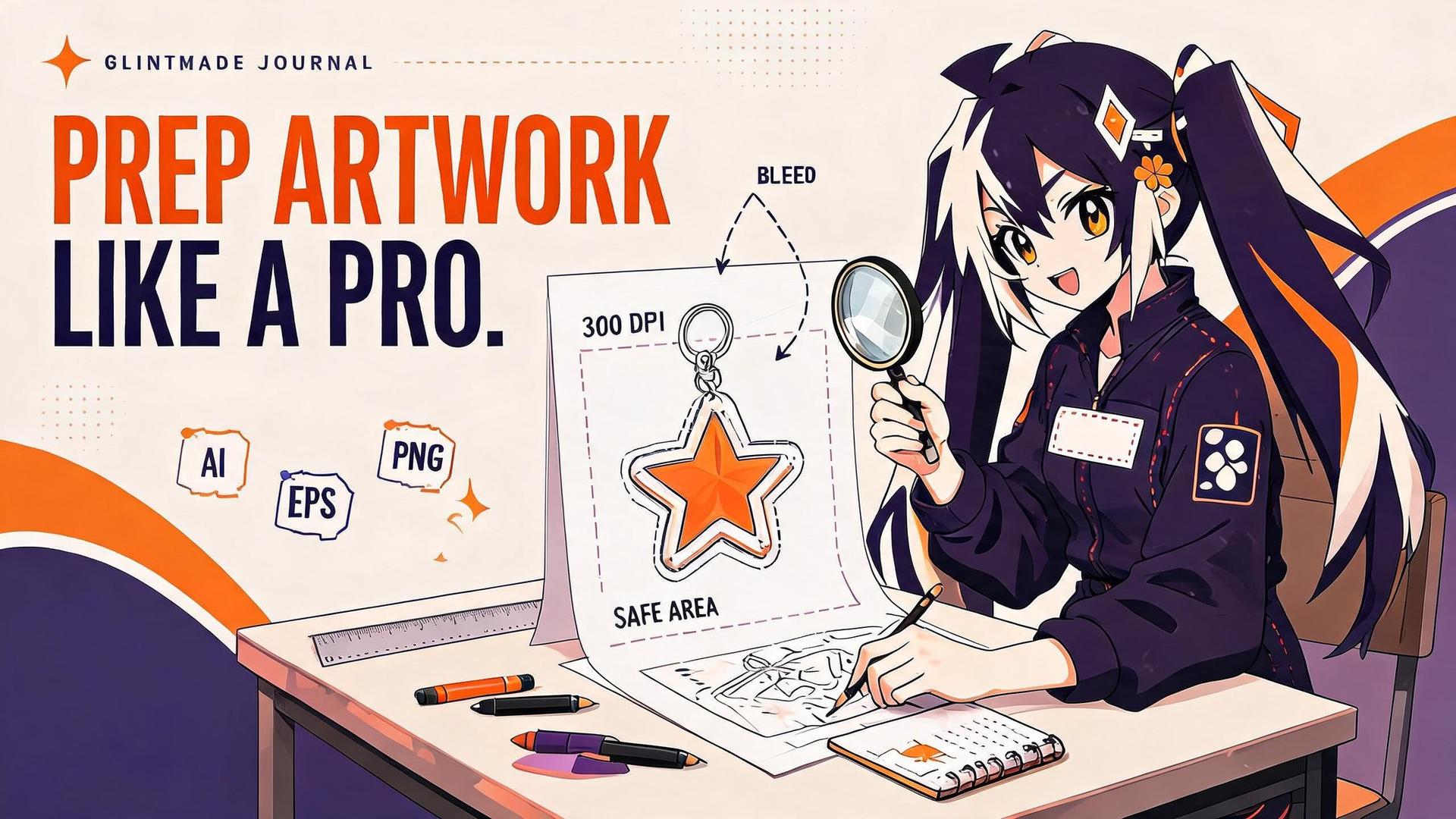
To work directly with an acrylic keychain supplier, submit vector files (AI, PDF, EPS) or high-resolution raster files (PSD, PNG at 300 DPI minimum) with a dedicated Spot Color channel for white ink. Maintain a consistent bleed expansion outside your cut line and keep critical artwork inside safe zone margins. Choose between clear acrylic for transparent backgrounds or frosted acrylic for diffused light. Production in a Wenzhou factory typically takes 7 to 15 business days, followed by air freight (5 to 10 days) or sea freight (25 to 40 days) to the US. Verify direct manufacturing capacity by requesting facility video calls, raw material invoices and specific machine model numbers.
01
Key Takeaways
Before the detail, these are the decisions that matter most when specifying acrylic keychain supplier.
- Set up a dedicated Spot Color channel named 'White' in Illustrator or Photoshop so the RIP software correctly applies white ink layers behind your CMYK artwork.
- Apply a uniform bleed expansion beyond the cut path and enforce safe zone margins inward to prevent edge-trimming from clipping your design.
- Select clear acrylic when you need transparent negative space, and choose frosted acrylic when you want a matte surface that diffuses backlighting.
- Plan your convention inventory using dual-track timelines: 7 to 15 days for factory production plus either 5 to 10 days for air freight or 25 to 40 days for sea freight.
- Verify a supplier is a true acrylic keychain manufacturer by requesting live video walkthroughs of their Wenzhou factory floor and asking for their UV flatbed printer model numbers.
02
Defining Direct Manufacturing Capacity
An acrylic keychain supplier with direct manufacturing capacity operates the UV flatbed printers, CNC cutting machines and assembly lines used to produce your order. They do not outsource production to a third party or act as a middleman routing files between you and an unknown facility. When you work with a manufacturer that owns its equipment, you communicate directly with the technicians running the RIP software.
This distinction matters for file preparation and quality control. A broker cannot answer technical questions about white ink spot color channels, bleed expansion tolerances or specific material thicknesses because they do not oversee the print run. Direct factory ownership means your artwork files are evaluated by the people who will physically calibrate the printer heads and load the clear or frosted acrylic sheets.
For US-based creators and convention vendors, partnering with a factory-owned supplier eliminates redundant communication loops. Revisions happen faster when the person reviewing your layer structure is the same person operating the machinery. This operational model applies across our Wenzhou factory floor, whether we are producing a run of custom acrylic keychains or larger format items like standees.
03
Verifying Your Acrylic Keychain Maker Owns the Equipment
Many suppliers marketing themselves as an acrylic keychain manufacturer operate strictly as brokers. They take your order, add a margin, and pass the files to a third-party facility. This structure introduces communication delays. Technical questions about UV flatbed printing or RIP software must travel through an intermediary who does not control the hardware. For US creators managing tight convention schedules, this extra step increases the risk of file errors reaching the press bed.
You can verify direct manufacturing capacity by requesting specific documentation. Ask for a current business license that lists production activities rather than just trading. Request unedited video footage showing your exact artwork files being processed on their RIP software and printed on their machines. A factory with its own equipment in Wenzhou will provide this without hesitation. Brokers typically rely on stock footage or generic photos of machinery they do not own.
Evaluate how the supplier handles technical constraints. Ask them directly about bleed expansion rules, safe zone margins, or spot color channel setup. A true acrylic keychain maker operating its own floor answers these questions with precise measurements and layer structures. If the response is vague, promises to check with the production team, or contradicts standard prepress requirements, you are likely speaking to a middleman.
Working with a verified direct factory like Glintmade means your files move straight from submission to our Wenzhou production line. We control the entire process for custom acrylic keychains, from material selection to final hardware assembly. This eliminates broker markups and ensures the specifications you approve are the exact parameters used during manufacturing.
04
File Formats and Layer Structure for UV Flatbed Printing
Before your artwork enters the factory's RIP software for UV flatbed printing, it must meet strict file requirements. Submit your designs as vector PDFs or high-resolution PNG files with transparent backgrounds. Raster elements require a minimum resolution of 300 DPI at actual print size. Lower resolutions produce pixelated edges on small items like a custom acrylic keychain. Avoid submitting flattened JPEGs, as they cannot support the necessary separation between color and white ink layers.
Layer organization dictates how the printer applies ink to the substrate. Your file must contain distinct, clearly named layers. The bottom layer holds the white ink mask, which provides opacity so colors remain visible against clear or frosted acrylic. The top layer contains your CMYK color artwork. If you are designing double-sided charms, include separate layers for the front and back art. Do not merge these layers. A single flattened image prevents the RIP software from routing white and color inks through their respective printheads.
When setting up your canvas, outline all text and expand strokes into filled shapes. Unexpanded strokes can shift during processing, resulting in misaligned cut lines. Keep your design grouped within a single artboard sized exactly to your intended keychain dimensions, plus the required bleed expansion. Naming conventions matter here. Label your layers explicitly, such as "White Ink" and "CMYK Artwork," so the machine operator does not need to guess your intent. Proper file structure eliminates manual corrections by the acrylic keychain maker and prevents production delays.
| Property | Clear Acrylic | Frosted Acrylic |
|---|---|---|
| Surface Finish | Glossy, transparent | Matte, semi-translucent |
| Background Visibility | Fully see-through where unprinted | Diffused, obscures background details |
| White Ink Requirement | Required under all colored areas for opacity | Required under all colored areas for opacity |
| Light Interaction | Direct transmission | Scattered transmission |
| Best Use Case | Stained-glass effects, floating character art | Soft aesthetic, hiding internal hardware or layered prints |
05
Setting Up the White Ink Spot Color Channel
UV flatbed printing on clear or frosted acrylic requires a dedicated white ink layer. Without it, your CMYK colors print directly onto the transparent substrate and appear washed out. The factory RIP software reads this white layer as a specific Spot Color channel, instructing the printhead to lay down an opaque base before applying color inks.
In Adobe Illustrator, duplicate your artwork shape and place it on a separate layer above your design. Select the fill, open the Swatches panel, and create a new spot color. Name this swatch exactly "White" with no spaces or variations. Set the color type to Spot Color rather than Process. If you name it incorrectly, the RIP software will not recognize the channel and the printer will skip the white backing entirely.
In Photoshop, build your white mask using a Spot Color channel instead of a standard layer. Open the Channels panel, select New Spot Channel from the menu, and name it "White". Paint the areas requiring opacity using solid black within that channel. The RIP software interprets the black pixels in this Spot Color channel as locations for white ink deposition.
Always export your final file as a PDF or PSD with the spot channels preserved. Flattening the document converts the spot color into process values, destroying the white ink data. When working with an acrylic keychain manufacturer, confirm their exact naming convention for the spot channel before submitting your files, as some RIP configurations require specific capitalization.
| Logistics Phase | Air Freight | Sea Freight |
|---|---|---|
| Factory Production | 7 to 15 business days | 7 to 15 business days |
| Transit Time | 5 to 10 days | 25 to 40 days |
| Total Estimated Lead Time | 12 to 25 business days | 32 to 55 business days |
| Ideal For | Urgent convention deadlines, sample batches | Bulk inventory, planned seasonal releases |
06
Bleed Expansion and Safe Zone Margins
When you prepare artwork for a custom acrylic keychain, the cut line defines the exact shape of the finished piece. UV flatbed printers require your background colors and patterns to extend past this boundary. This extension is called bleed expansion. You must add 2mm (approximately 0.08 inches) of extra artwork beyond the cut line on all sides. If your design stops exactly at the edge, minor shifts during the CNC cutting process will leave thin, unprinted transparent lines along the perimeter of the acrylic.
The safe zone works in the opposite direction. It dictates how far inward you must keep text, logos and critical visual elements from both the outer cut line and the hardware drill hole. Maintain a minimum margin of 3mm (approximately 0.12 inches) inside the cut path. For the area surrounding the attachment hole, increase that clearance. Hardware holes are typically drilled at 3mm to 4mm in diameter, and placing fine details too close risks them being partially removed or visually crowded by the metal jump ring.
RIP software reads these spatial boundaries as distinct vector paths. Your file must clearly separate the bleed path, the cut path and the safe zone. When an acrylic keychain manufacturer imports your document, the operator aligns the print layer to the cut path while ensuring the bleed extends outward. Failing to define these margins accurately forces the factory to guess your intent, which often results in rejected files or delayed production runs.
07
Clear Versus Frosted Acrylic Substrates
When you select a material for your custom acrylic keychains, the substrate determines how light interacts with the UV-cured ink. Clear acrylic is optically transparent. Light passes directly through unprinted areas, allowing you to see whatever sits behind the charm. This transparency requires precise white ink layering beneath your color channels so the design remains opaque when held against dark clothing or convention table surfaces.
Frosted acrylic introduces a matte surface texture that scatters light rather than transmitting it cleanly. The material appears semi-translucent. Background objects look blurred and softened when viewed through the plastic. A frosted acrylic keychain reduces glare under harsh convention hall lighting, making printed details easier to read from multiple angles without reflection interference.
Your choice depends on the visual effect your artwork demands. Clear substrates suit designs that rely on background visibility or layered elements, such as those used in a custom floating acrylic shaker keychain where internal pieces need to be seen through the outer shell. Frosted materials work better for solid character illustrations where you want a uniform, non-reflective finish that mimics traditional print stock.
08
Production Timelines and Shipping Routes to the US
Once your artwork files pass prepress checks, the production clock starts at our Wenzhou factory. UV flatbed printing, CNC cutting, hardware assembly and quality inspection typically require 7 to 10 business days for standard orders. Complex builds like multi-layer designs or specialty finishes may add a few days to this window. Because Glintmade operates its own equipment, there is no third-party handoff delaying the schedule.
After manufacturing completes, you choose between two shipping routes to the US. Air freight moves your finished keychains from the factory floor to your door in roughly 5 to 10 days, plus 1 to 2 days for customs clearance. This track suits convention vendors working against a hard event date who need inventory fast.
Sea freight takes approximately 25 to 40 days from departure to US delivery. The longer transit time lowers your per-unit shipping cost significantly. Indie IP owners ordering large batches of custom acrylic keychains for online store restocks usually select this route to preserve margins on high-volume runs.
Your total timeline combines the 7 to 10 day production phase with your selected shipping method. A rush order via air freight arrives in about 2 to 3 weeks from file approval. A sea freight shipment requires 6 to 8 weeks total. Direct factory control means these estimates remain consistent without broker scheduling conflicts.
09
Ordering Custom Acrylic Keychains With No Minimum
Brokers typically enforce high minimum order quantities because they need to justify the markup added between you and the factory floor. When you work with an acrylic keychain manufacturer that operates its own UV flatbed printers, those constraints disappear. The equipment can print a single sheet of acrylic containing one prototype or fifty different character designs in the same pass. You are paying for machine time and material, not a middleman's volume threshold.
This flexibility matters most if you sell at conventions or test new indie IP before committing to large inventory runs. You can order custom acrylic keychains with no minimum through our Wenzhou factory, allowing you to validate which characters resonate with your audience. A low-volume run lets you check color accuracy on clear versus frosted substrates, verify hardware fit, and confirm that your bleed expansion and safe zone margins translated correctly from screen to physical product.
Low-quantity orders follow the exact same file preparation standards as bulk production. Your artwork must still include the properly named white ink Spot Color channel, adhere to the required bleed rules, and arrive in the correct format for our RIP software. The factory does not alter its technical intake process based on quantity. Review the specifications for custom acrylic keychains to ensure your files are structured correctly before submitting a small-batch order.
10
Frequently Asked Questions
A direct acrylic keychain supplier requires vector files such as AI, EPS or PDF for cut paths, alongside high-resolution raster files like PSD or PNG at 300 DPI for the printed artwork. Layers must be separated clearly. Your file needs distinct layers for the CMYK print data, the white ink backing and the cut line. The factory RIP software reads these specific layer structures to align the UV flatbed printing heads with the CNC cutter.
To set up the white ink spot color channel in Illustrator, create a new spot color swatch and name it exactly as the manufacturer specifies, often "White" or "W". Apply this swatch to a separate layer positioned beneath your CMYK artwork but above the cut path. In Photoshop, open the Channels panel and create a new spot channel using the same naming convention. Fill the areas requiring opaque backing with 100% solid color on this channel so the printer lays down white ink correctly behind transparent sections.
Artwork must include a bleed expansion extending past the final cut line to prevent unprinted edges after die-cutting. Keep all critical design elements, text and facial features within the safe zone margins, staying well clear of both the outer edge and the drill hole placement. Refer to the bleed and safe zone rules detailed earlier in this guide for exact measurements before submitting your files for custom acrylic keychains.
Clear acrylic provides full transparency, allowing light to pass directly through unprinted areas. A frosted acrylic keychain uses a matte substrate that diffuses light, softening colors and reducing glare. Production timelines from our Wenzhou factory depend on order volume, followed by transit via air freight or sea freight to the US. To verify an acrylic keychain manufacturer actually owns their equipment rather than acting as a broker, request time-stamped video walkthroughs of the UV flatbed printers and ask for facility documentation matching their business registration.
FAQ
Frequently asked questions
What file formats and layer structures does a direct acrylic keychain supplier require?
A direct supplier requires vector files such as AI, PDF or EPS, or high-resolution raster files like PSD or PNG saved at a minimum of 300 DPI. The layer structure must separate your CMYK artwork from the white ink backing. You must create a dedicated Spot Color channel specifically named for white ink so the factory's RIP software can read it as a distinct print pass rather than blending it into the standard color profile. All text should be converted to outlines before submission.
How do you set up the white ink spot color channel in Illustrator or Photoshop?
In Illustrator, open the Swatches panel, create a new spot color, name it exactly as the factory specifies (typically 'White'), and apply this swatch to the shapes that require opaque backing. Place this layer beneath your CMYK artwork. In Photoshop, open the Channels panel, create a new Spot Channel, name it 'White', and paint the areas requiring white ink using 100% solid black on that specific channel. This tells the UV flatbed printer where to lay down the white base layer.
What are the bleed and safe zone rules for acrylic keychain artwork?
Your artwork must include a bleed expansion that extends uniformly past the final cut line to ensure no unprinted edges appear after CNC routing. Critical design elements, including text and facial features, must remain inside the safe zone margins, which sit inward from the cut line. You must also account for the hardware drill hole by keeping essential artwork away from the designated punch area at the top of the keychain shape.
What is the difference between clear and frosted acrylic for keychains?
Clear acrylic is fully transparent, allowing light to pass directly through unprinted areas, making it ideal for designs that rely on negative space or stained-glass effects. Frosted acrylic has a matte, semi-translucent surface that scatters light. It obscures whatever is behind the keychain while providing a softer visual texture. Both materials require a white ink layer printed via UV flatbed technology beneath the CMYK colors to make the artwork opaque and vibrant.
How long does production and shipping take when ordering from a China-based factory to the US?
Production at a Wenzhou factory typically requires 7 to 15 business days after artwork approval. From there, transit depends on your chosen route. Air freight delivers the finished keychains to the US in 5 to 10 days, resulting in a total lead time of 12 to 25 business days. Sea freight takes 25 to 40 days in transit, bringing the total timeline to 32 to 55 business days. Convention vendors must calculate backward from their event date using these dual tracks.
How can you verify a supplier actually owns their manufacturing facility?
Request a live video call to walk the factory floor and observe the UV flatbed printers and CNC cutting machines in operation. Ask the supplier for the specific brand and model numbers of their equipment. A genuine acrylic keychain manufacturer will readily provide raw material purchase invoices for acrylic sheets and hardware components. Brokers typically cannot provide real-time facility access or specific machine documentation.