FanX Salt Lake 2026 runs September 24–26, 2026 at the Salt Palace Convention Center in Salt Lake City. The FanX Salt Lake 2026 guide tracks tickets, guests and show hours for attendees. The merchandise production window for the 2026 show is closed. If you are planning merchandise for the 2027 cycle, your production window opens in early spring — FanX has historically held the late-September slot. The timeline below runs from artwork handoff at our Wenzhou factory to delivery at your door in the US: factory lead times for standard and complex acrylic items, international shipping durations, and an artist alley inventory formula based on daily transactions rather than guesswork. It targets the 2027 event exclusively.
FanX Salt Lake Comic Con typically occurs in late September. To have custom merchandise ready for FanX 2027, submit finalized artwork to your manufacturer by April 2027. Standard acrylic keychains require approximately 15 days of factory production, while complex items like shakers take 20 to 25 days. Ocean freight from Wenzhou to the US West Coast adds 25 to 35 days of transit time. Calculate your artist alley inventory by multiplying your target daily sales volume by the number of convention days, then adding a 20 percent buffer for peak traffic.
01
Key Takeaways
Before the detail, these are the decisions that matter most when specifying fanx dates.
- Target April 2027 for artwork submission to align with FanX's historical late-September schedule, accounting for 15 to 25 days of factory production and up to 35 days of ocean transit.
- Standard acrylic keychains require shorter manufacturing windows than complex items like shaker keychains or multi-layer standees, which demand additional assembly and curing time.
- Ocean freight from Wenzhou to the US West Coast takes 25 to 35 days; air freight reduces this to 7 to 10 days but significantly increases unit costs for heavy acrylic items.
- Calculate artist alley inventory using a transaction-based formula: multiply expected daily sales by the total number of convention days, then add a 20 percent buffer.
- If you miss the spring production window for FanX 2027, redirect your manufacturing run toward later Q4 conventions like New York Comic Con or L.A. Comic Con.
02
Historical Scheduling Baseline for FanX Salt Lake
FanX Salt Lake Comic Con has historically taken place in late September. While you may be searching for FanX dates to confirm the 2026 schedule, that preparation window is already closed. Manufacturing and international transit require months of lead time. If your artwork is not currently in production, you cannot reliably stock a booth for the 2026 event. Your planning target must now shift entirely to FanX 2027.
Using the historical late-September timing as a fixed anchor allows you to build a backward-planning calendar. You should start producing merch for FanX 2027 in early spring of that same year. This timeline accounts for file proofing, factory manufacturing in Wenzhou, ocean freight transit, domestic US delivery, and final packing for your artist alley inventory planning.
Establishing this baseline prevents scheduling conflicts with other fall events like New York Comic Con or L.A. Comic Con. By locking late September 2027 as your delivery deadline today, you can allocate specific weeks for manufacturing standard acrylic goods versus complex multi-layer items without compressing the convention merch production timeline.
03
Factory Production Durations in Wenzhou
Manufacturing timelines at our Wenzhou facility depend entirely on the structural complexity of your order. Standard single-layer acrylic items, such as a basic custom acrylic keychain or flat standee, require fewer production steps. Once your files pass pre-press review and materials are staged, the factory completes cutting, UV printing, and hardware assembly for these straightforward goods in approximately 10 to 15 business days.
Complex designs introduce additional curing, assembly, and sealing stages. Products like a custom floating acrylic shaker keychain or a custom acrylic shaker keychain involve internal cavities, loose components, and oil fills that must cure before ultrasonic welding seals the edges. Multi-piece configurations, including a custom acrylic combo standee, also extend the timeline. You should allocate 18 to 25 business days for these specialized builds.
These durations cover physical manufacturing only. They begin after artwork approval and do not include transit time from Wenzhou to your US address. When you build your convention merch production timeline, treat these factory windows as fixed variables. Rushing UV ink curing or ultrasonic sealing compromises the structural integrity of the acrylic, so our floor schedules do not compress these steps.
04
International Transit Math from Wenzhou to the US
Once your merchandise leaves the factory floor in Wenzhou, transit time depends entirely on the freight method you select. Ocean freight from Wenzhou to major US West Coast ports typically requires 25 to 35 days door-to-door. This duration accounts for inland trucking to the departure port, vessel transit across the Pacific, customs clearance at the destination port, and final ground delivery to your address. If you are shipping heavy items like bulk orders of custom acrylic standees or thick acrylic blocks, ocean freight remains the standard choice due to weight-based pricing.
Air freight compresses that timeline significantly. Door-to-door air shipments from Wenzhou to the US generally take 7 to 12 days. This includes cargo handling at the origin airport, flight time, US customs processing, and last-mile courier delivery. Air freight is the necessary route if you are producing lighter, high-margin goods such as custom acrylic keychains or holographic stickers and need them delivered quickly.
These transit windows assume normal customs processing without holds or inspections. Add your chosen shipping duration directly to the factory production lead time to get your total order timeline. For example, a 15-day manufacturing run combined with 30 days of ocean transit yields a minimum 45-day total lead time before the inventory reaches your hands. This equation forms the foundation for backward planning from late September 2027.
| Variable | Standard Acrylic Keychain | Complex Acrylic Item (Shaker/Multi-layer) | Stickers | Canvas Bags |
|---|---|---|---|---|
| Factory Production Time | 15 days | 20 to 25 days | 10 to 12 days | 15 to 20 days |
| Ocean Freight (Wenzhou to US West Coast) | 25 to 35 days | 25 to 35 days | 25 to 35 days | 25 to 35 days |
| Air Freight (Wenzhou to US) | 7 to 10 days | 7 to 10 days | 7 to 10 days | 7 to 10 days |
| Total Lead Time (Ocean) | 40 to 50 days | 45 to 60 days | 35 to 47 days | 40 to 55 days |
| Total Lead Time (Air) | 22 to 25 days | 27 to 35 days | 17 to 22 days | 22 to 30 days |
05
The Reverse-Engineered 2027 Production Calendar
To build a reliable convention merch production timeline for FanX Salt Lake 2026 and beyond, you must work backward from the event date. FanX historically occurs in late September. Using late September 2027 as your anchor, subtract ocean transit time, factory production days, and artwork proofing periods to find your exact start date. If you are producing standard acrylic standees or keychains that require 15 days of manufacturing and 30 days of ocean freight, your finished goods leave Wenzhou by mid-August 2027. That means production begins in late July 2027, and your final artwork files must be approved by early July.
Complex items like custom floating shaker keychains or multi-layer wooden badges demand longer factory runs. A 25-day production window pushes your manufacturing start date into late June 2027 under the same ocean freight schedule. If you opt for air freight to compress the transit leg to 7 days, you gain roughly three weeks of flexibility, moving your production deadline into August. However, air freight increases your per-unit cost significantly. You must weigh this expense against the risk of missing the show floor entirely.
The table below maps these variables side by side for a late September 2027 delivery target. It assumes a 5-day artwork proofing period before the factory clock starts.
06
Transaction-Based Inventory Formula for Artist Alley
Artist alley inventory planning requires math, not intuition. To calculate how many units to order for a multi-day convention like FanX Salt Lake, you need three variables: your expected daily transaction count, the number of days the event runs, and a buffer percentage for unexpected demand spikes.
Start with your baseline transaction rate. If historical data or comparable shows indicate you process 20 sales per day for a specific item like a custom acrylic keychain, multiply that by the total days of the convention. For a three-day event, that yields 60 units. Add a 15 to 20 percent buffer to account for peak foot traffic hours. Your final production order becomes 72 units.
Apply this formula individually to each SKU in your lineup. A high-volume item like a custom holographic sticker will have a different daily transaction rate than a complex piece such as a custom floating acrylic shaker keychain. Do not average these numbers together. Calculate the required quantity per product based on its own price point and past conversion rate.
Once you have your per-SKU totals, sum them against the factory minimum order quantities at our Wenzhou facility. If your calculated requirement falls below the production threshold for a given item, adjust your pricing strategy or consolidate designs to meet the minimum without over-ordering dead stock.
07
Artwork Handoff Requirements for Acrylic Goods
The production clock for your FanX 2027 merchandise does not start when you send an email. It starts when the factory receives files that meet exact technical specifications. Submitting incomplete or incorrectly formatted artwork delays manufacturing and compresses your shipping window. Every file must be finalized before handoff.
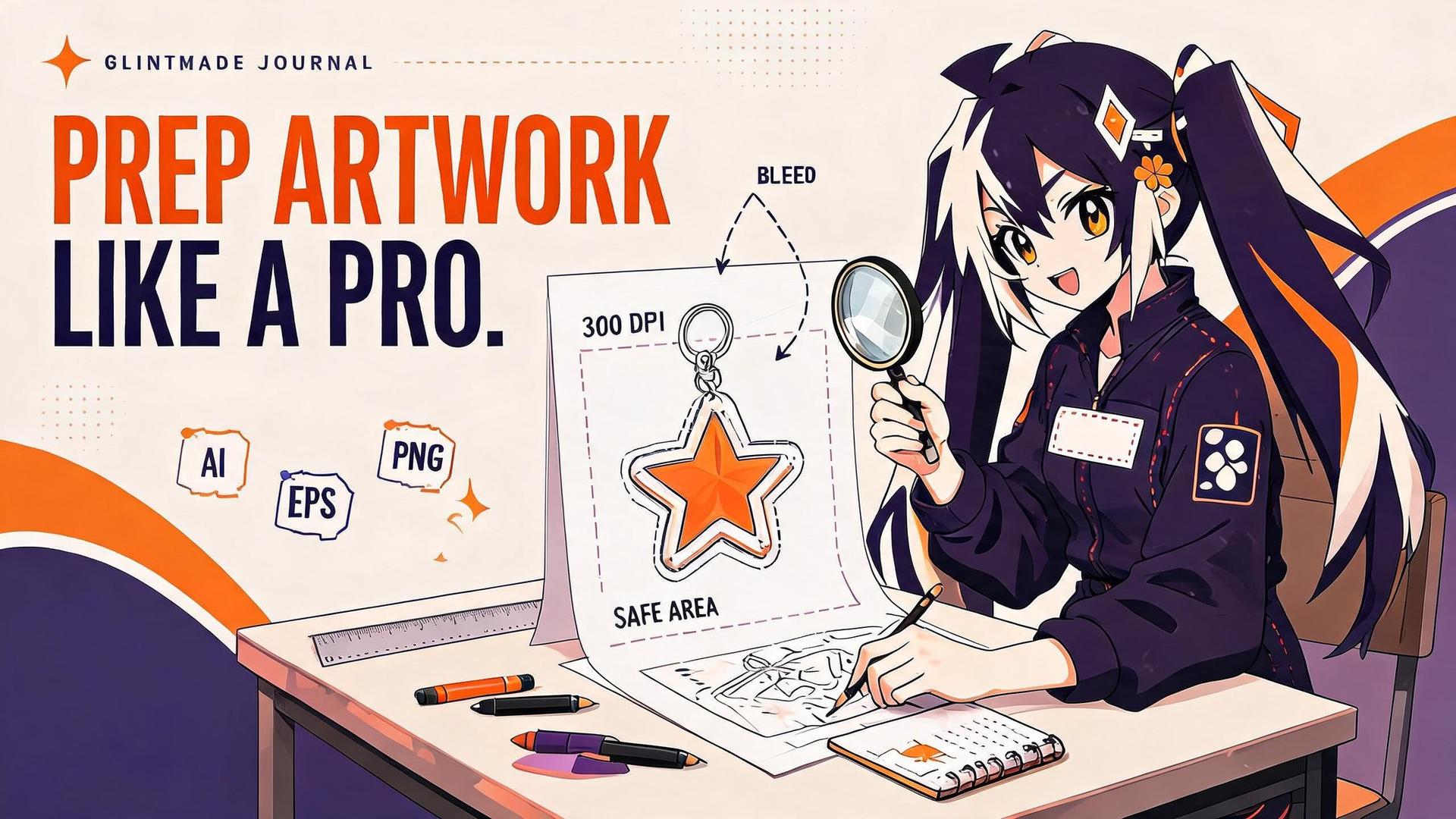
Provide vector artwork in AI, PDF, or EPS formats. Raster images must be submitted as PSD or PNG files at a minimum resolution of 300 DPI. Set your color mode to CMYK. RGB files will shift during printing, altering your intended colors on the final acrylic surface.
Include a 2mm bleed around the entire perimeter of your design. This extra margin accounts for minor shifts during the UV printing and die-cutting stages. Without it, the cutting blade may leave a thin white edge on your finished product. Keep critical text and facial features at least 3mm inside the cut line.
Structure your layers clearly. Separate the front print, back print, and die-cut path into distinct, labeled layers within the same file. If you are ordering specialty items like a custom floating acrylic shaker keychain or a custom glow-in-the-dark acrylic badge, add dedicated layers for internal components or specific ink effects. A disorganized file requires manual interpretation by the prepress team, which adds days to your timeline.
08
Alternative Convention Routing for Late Planners
If you miss the production window for FanX Salt Lake 2026 or fall behind on your 2027 timeline, you do not need to hold inventory in storage for a full year. You can route the same manufactured goods to other major events that occur later in the calendar. New York Comic Con (NYCC) typically takes place in October, while L.A. Comic Con generally falls in late autumn or early winter. Both events draw large artist alley crowds and accept the same product formats you would have brought to Utah.
The convention merch production timeline does not change based on your destination city. A batch of custom acrylic keychains or custom floating acrylic shaker keychains requires the same factory lead time in Wenzhou regardless of whether you are selling them in Salt Lake City or New York. The only variable that shifts is your domestic transit leg. Shipping from a US port to the East Coast versus the West Coast alters ground freight duration by a few days, which you must factor into your final delivery date.
When rerouting inventory, verify table dimensions and display rules for the new venue. NYCC and L.A. Comic Con enforce specific booth footprint limits. Items like a custom thick acrylic block or a custom rotating acrylic stand take up different amounts of table space than flat prints. Map out your artist alley inventory planning using the transaction formula from the previous section, adjusting your daily sales estimates to match the attendance scale of the replacement event rather than carrying over your original FanX projections.
09
Frequently Asked Questions
Customs inspections at US ports of entry can add unpredictable delays to your transit math. Ocean freight containers are subject to random holds that typically extend the journey by three to seven business days. Air freight clears faster but still requires accurate commercial invoices and packing lists to avoid processing bottlenecks. When building your reverse-engineered calendar for FanX 2027, pad your final delivery date by at least one week beyond the baseline shipping estimates. This buffer protects your artist alley setup schedule if your shipment is flagged for a routine examination.
Production minimums depend on the specific item you are ordering. Standard single-layer acrylic goods like a custom acrylic keychain generally require a minimum run of 50 units per design. Complex items involving multiple layers, internal shaker components, or specialized hardware such as those found in a custom floating acrylic shaker keychain often carry higher minimum order quantities due to the setup time required on the factory floor in Wenzhou. Confirm the exact threshold for your chosen product before submitting your artwork files, as orders below the minimum cannot enter the production queue.
The proofing stage occurs after you submit your files but before the manufacturing clock starts. Our team reviews your artwork for bleed alignment, cut lines, and color layer separation. You will receive a digital proof for approval. This review cycle typically takes two to four business days, depending on how quickly you respond to revision requests. If your file requires structural adjustments—such as repositioning a drill hole for hardware—the proofing phase extends until the layout meets production specifications. Factor this approval window into your early spring start date to ensure your goods ship on schedule.
FAQ
Frequently asked questions
What happens if my shipment is delayed at US customs?
Customs clearance typically takes 3 to 5 days within the stated transit window. However, inspections can add unexpected delays. Building a two-week buffer between your projected arrival date and the convention start date protects against these hold-ups. This is why the April 2027 artwork deadline is strict for a late-September event.
Can I use air freight for my entire FanX 2027 inventory?
You can, but air freight is cost-prohibitive for heavy items like bulk acrylic standees or canvas bags. Creators typically reserve air freight for lightweight, high-margin goods like holographic stickers or small batches of premium keychains, while shipping the bulk of their inventory via ocean freight.
How early should I request a digital proof before production begins?
Request your digital proof immediately upon submitting artwork. Reviewing cut lines, white ink layers, and color profiles takes time. The 15 to 25-day factory production clock does not start until you formally approve the proof. Delays in approval directly compress your shipping buffer.